
Pasta History: The Carbonara Files #1
- Mark Gowen
- Oct 16, 2025
- 6 min read


Did Carbonara kill the Kitten Star?
Both irresistible and both over-exposed, has the kitten been toppled from the top of our feeds? If the algorithm gets a whiff of your foodie likes, the answer for you is probably yes it has.
I’m probably a textbook case. I can remember when every other social media video featured a fwuffy bundle of mischievous laughs. But now, sadly, no more. It seems that felines are B-list when it comes to featuring on my social feed.
Maybe it is just down to the algorithm, but all I seem to see nowadays is the same twirl of pasta, dripping with golden custard and dressed with the obligatory crispy pig.
And then it begins. The 'creamy but without cream' voice over or caption. The 1944 Liberation of Rome myth, army rations, coal miners, charcoal burners and the 1950s and on and on.
But we've got the comments to look forward to.
Everyone (usually) loves everyone on Instagram, so it’s compliment, compliment, compliment. But in certain Facebook Groups, posting Carbonara is like kicking open the saloon doors to sudden silence. The piano's stopped, the dancing girls have frozen and all eyes turn to you.
Then the preaching. If you're lucky it's preaching without insults. If you're me, it's no-holds-barred preaching and it’s a struggle not to retort.
It's a stock script: 'it can't be Carbonara if it hasn't got guanciale' ... 'there's no cream / pancetta / garlic' in Carbonara'... 'Carbonara needs more sauce than that,' etc.
And I sigh. Because over even just the last 70 years, there have been many, many incarnations of Carbonara which have shared all of those traits.
But today social media says we can't call them Carbonara any more.
Is it even possible to find the authentic carbonara recipe any more?
Quick answer? Definitely maybe… but as you may have already guessed, it rather depends on which Carbonara you’re looking for.
My own experience is that the more you try and search for the 'authentic' or 'original' carbonara, the more you'll find yourself going round and round in circles. And that’s assuming you're able to find something different from the custard-and-pig-fest that social media tells you Carbonara should be nowadays.
Whilst the internet’s second most searched pasta sauce (behind only Spaghetti al Pomodoro) has origins that were first documented over 500 years ago in the region of Umbria, Carbonara’s passage down the generations of cooks, together with its migration to Rome and beyond have ensured an enduring, baffling canon of recipes.
On the other hand, and let's be positive, such a wide spectrum of variations and methods for just one recipe does of course open up the potential for a fascinating voyage of discovery.

contemporary carbonara and the carbo-purists
Here's a Carbonara that I had the misfortune to eat recently in Trastevere in Rome. I say 'misfortune' because Contemporary Carbonara (CC) really isn't something I enjoy, and that's not just because I'm old enough to remember quite a few previous incarnations of Carbonara.
I don't like Contemporary Carbonara because, like those kittens, it's everywhere on my social media feeds, begging me to like it. And each time I see another version pop up I can't help thinking that social media's ‘more is more’ visual culture is entirely responsible for turning this one recipe into an often inedible, over-blown cliché of itself. A bit like pizza with comedy, ballooning crusts... Oh, you thought that's what pizza was supposed to look like? I rest my case.
Carbonara - or more precisely, the core combination of ingredients in this pasta sauce - have been in the public domain since at least 1494 (and that’s a long time ago... that's 5 years after the completion of the Sistine Chapel in Rome!).
But just 15-20 years ago, a Carbonara cooked and plated like this one just didn't exist anywhere. Before the early 2000s, Carbonara was very rarely cooked and served with large amounts of just-cooked, eggy, cheesy sauce. Just a few years before that, in the mid 1990s, the recipe didn't even regularly feature guanciale as the pig of choice. In the 1980s, most Carbonare with decidily dry affairs with well- cooked, often semi-scrambled eggs. Not much pepper, but a strong chance that garlic or onions might be involved too. We could go back further and dive into the cream years, but let's hold onto those thoughts for a moment.
Carbonara just isn't what it used to be.
Within my own lifetime, there have probably been a handful of different fashions for cooking Carbonara, and I can vividly remember eating and cooking quite a few on them.
But make a Carbonara today that deviates from the purists' mantra of guanciale-pecorino-yolks-pepper and you can expect to be picked up swiftly by undercover agents of the Carbonara Police. I'm sure you've met them. They're normally the ones who criticise without having the faintest idea of the recipe's origins and roots.
If there's one recipe that illustrates how dishes change and evolve and which haven't even always used the same ingredients, it's Carbonara.
And if there's one thing that can lift your cooking and inspire and give you the chance to discover new tastes and flavours, it's knowing the cooks we used to be.
Once upon a time in Umbria

This is Monteleone di Spoleto in Umbria, which I visited a couple of years ago and where, every 16 August, the town holds the 'Sagra degli Strascinati di Monteleone di Spoleto' - the Festival of the Strascinati (long, hand-pulled pasta a little like pici, though sometimes shorter) of Monteleone. The festival commemorates an event at the end of the 15th Century when a pasta dish was created in order to bribe warlords who had been threatening to torture hostages snatched from the town (read the full account of the event in Pasta & Magic: Dairy Sauces). The dish? Fresh pasta 'strascinati' served in none other than a sauce of pecorino and egg yolks with guanciale and local sausages.
And that's HUGE, in terms of the history of Carbonara. A documented recipe dating back to the end of the 15th Century that includes the main ingredients of Contemporary Carbonara and establishes them in the local regional cooking tradition.

In Pasta & Magic: Dairy Sauces ( to be published 2026) - and perhaps even in this blog too in the near future - you'll be able to read about how that one dish found its way, down the centuries and across Umbria into Lazio and then to Rome.
For the moment though, here's a modern recreation of what Carbonara's ancestor may have looked ilke.
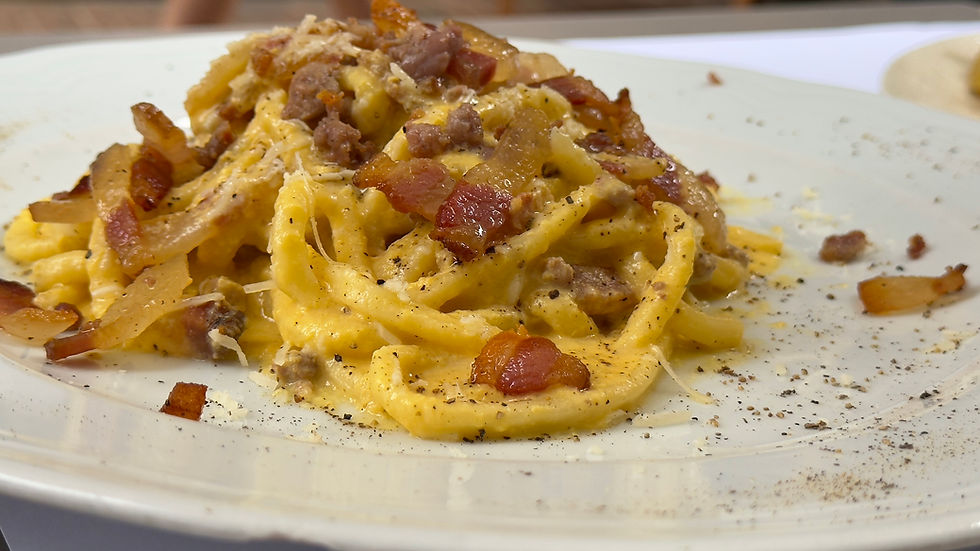
This is a plate of Strascinati ('dragged' pasta) with a Carbonara that I ate in Perugia, Umbria this summer. As well as a pretty contemporary plating with copious amounts of pecorino and yolk sauce, it had a mix of guanciale and local pork sausage. Exactly the same mix of pigs as popped up in 1494 in Monteleone di Spoleto.
And here's a version of it that I cooked myself last week in London.

As you can see, my preference is for less 'custard'... but, joking apart, I really do think a moist, subtle glaze is so much better (and edible!) than the excessive sauce treatments that are everywhere on social media. I did cook it in the contemporary 'carbo-crema' style, but I was, as you can see, relatively economical with the yellow stuff.
If you'd like to taste what one of the ancestors of modern Carbonara tasted like, look out for the full recipe, which will be published in this blog shortly.
Coming in the next instalments of the Carbonara Files:
The real story of how history never forgot Carbonara's 15th century origins
Carbonara in the early 20th Century
The myth of the 'Liberation of Rome' Carbonara
Alternative Carbonara


Comments